Sunday, January 6, 2013

Will the DS line save Citroen's skin?


Citroen is surprising even itself with the success of the DS line. So Citroen people are feeling confident when they say there will be three more DS cars. In 2014, a crossover SUV and a mid-size four-door saloon, then the next year a big saloon.
Plus all the current DS models will be upgraded, and be given the new face which will go onto those three big entrants. It's pretty much the same as what was on the gorgeous DS Numéro 9 concept shown at the Beijing show nine months ago. It consists of a brushed metal grille surround that sweeps into a pair of lateral wings. The lamps surround those wings in a C-shape.
OK, put up your hand if you drive a French big saloon or crossover. Or indeed a mid-size saloon of any brand except Audi, BMW or Mercedes. Frankly, Citroen's upward expansion of the DS line looks like a hiding to nothing.
Until you say one word. China. China will account for most of these big DSs, and by 2015 is expected to be the number one world market for DS. Citroen is building a factory there that will open by building DS5s, and add the crossover and saloon. They all use the same platform. The crossover will get 4WD through an electric rear motor like the DS5 Hybrid4.
The crossover would quite possibly sell OK in Europe. Several manufacturers who can't get anywhere with big saloons find they have done quite nicely with a crossover. VW couldn't give Phaetons away but has had a success with the Touareg. Honda's Legend stiffed and the Accord is a slow mover, but the CR-V is a runaway success. Lexus: no joy with the GS, but convoys of RXs sold.
But even so, we probably won't see the DS crossover, at least for a time. For a French manufacturer to bring in a vehicle from China would mightily p*** off the unions and politicians in France, after the company announced it wants to close its giant Aulnay plant just outside Paris. Unless Citroen tools up to build it in Europe too, it'll never come here.
Still, what are they like, these cars you can't have? The DS Concept 9 is massively wide and low, too much for production. But its looks will influence the big saloon. Other design elements you'll see on the crossover and saloons include a variation of the DS3's shark's-fin pillar treatment, and a brushed metal blade defining the edge of the roof. It's there in the DS5 already, and visible too on the Numéro 9.
But the elements will be juggled. The shark-fin pillar might be the C-post rather than the B-post, and the metal blade might run to the rear of the car, not the front. So they'll be recognisable as DS, but not different-sized clones.
The DS range is already helping get Citroen out of a big financial hole. On average, they sell for more than £4000 over and above what people pay for a Citroen C-model of the same size. They've sold 300,000 DS3s, DS4s and DS5s so far. Encouragingly, it's 65 percent conquest sales, ie from people who've had something other than a Citroen before. Very good business.

Friday, January 4, 2013

2013 Mercedes E-Class Coupe and Cabriolet facelifted


Official pictures of the revised Mercedes E-Class Coupe and Cabriolet

Following the reveal of the facelifted E-Class saloon and Estate last month, the Mercedes E-Class Coupe and Cabriolet have also received a fresh look and new technology.
Like the revised saloon, the E-Class Coupe and Cabriolet’s noses now feature two, single headlamp lenses rather than a pair of twin light units. However, the new LED-equipped lights do feature flowing daytime running lights which give the appearance of the quad headlights of the old model.
The new Coupe and Cabriolet also get new front bumpers with much more pronounced air intakes, while the rear of both feature revised LED tail-lights.
There’s a new rear bumper which has a wider diffuser, too, helping to give the car a more muscular stance, while the pontoon-style crease in the car’s flank that was ditched on the facelifted saloon is retained, and will become a trademark design feature reserved for the Coupe and Cabriolet models.
A three-tube instrument binnacle, analogue clock and redesigned air vents are transposed from the new saloon’s interior, and the gear selector on automatic models switches from the centre console to the steering column.
The drop-top car features the manufacturer's Aircap system as standard. Designed to reduce wind buffeting when the roof is lowered, the cap pops up from the top of the windscreen automatically when you hit 25mph, and lowers again when you slow below 9mph. Airscarf neck heaters built into the front seats are optional.
Both the Coupe and Cabriolet benefit from new safety kit derived from the next S-Class, including the stereo multi-purpose camera which enables the car to detect oncoming or crossing traffic, pedestrians and traffic signs.
An automatic city braking system is also fitted as standard, while the latest adaptive cruise control with steering assist to keep the car in its lane, and active high beam assist, which masks out part of the main beam of the LED headlights to prevent dazzling oncoming drivers, are on the options list.
The full UK engine range is yet to be confirmed, but two petrol and three diesel units will be offered. Mercedes’ new efficient four-cylinder BlueDIRECT petrol unit will also join the line-up.
Six-speed manual or 7G-Tronic auto gearboxes will be available when the car goes on sale in April. Prices will also be confirmed closer to the on-sale date.

2013 Audi R8 e-tron not for production


Production of all-electric Audi R8 e-tron has been delayed indefinitely

Audi has confirmed that the launch of its all-electric R8 e-tron has been delayed indefinitely. Originally scheduled to arrive in showrooms last year, the Mercedes SLS Electric Drive rival is now being treated purely as a technical exercise to advance electric car technology for models lower down the range.
“We’ve already built 10 cars which are being evaluated internally,” an Audi spokesman told us. “We’re concerned about the limited range of pure electric cars with existing battery technology, we don’t think the customers are ready to accept it.
“We now have a new head of technical development, Mr Durheimer, who is keeping a close eye on these sorts of projects, so we have to make sure it truly represents an Audi,” he continued. “Once technology improves who knows, never say never.”
Despite not being bound for production, full technical specs for the R8 e-tron were released recently in Audi’s technology magazine, Encounter. Power comes from a pair of electric motors producing a combined 376bhp. This enables the 1,780kg e-tron to cover 0-62mph in 4.2 seconds and hit a top speed of 124mph, while a full charge from a UK household socket takes around 12-hours and allows a range of 134 miles.

Thursday, January 3, 2013

2013 New Mercedes C-class details revealed


The all-new Mercedes-Benz C-class will look far more dramatic than today’s model and be imbued with a big dose of sporting intent.

The fourth-generation C-class will also be offered with the latest in-car networked internet connectivity and cutting-edge safety tech. These features are part of a bid to endow it with a more contemporary standing than ever before to take the challenge to the BMW 3-series.

The new model is set to get its first public airing in just over a year’s time at the 2014 Geneva motor show. It has been thoroughly re-engineered with the express aim of attracting younger buyers.

Mercedes insiders claim that little or nothing will be carried over from the existing C-class in a move described as a “new beginning” for the 3-series and Audi A4 rival.

“We want once and for all to discard the idea that the C-class is a car bought by your grandfather, ” said a high-ranking Stuttgart-based official involved in the new car’s conception. “We have gone to extensive lengths to ensure it will meet the expectations of a younger generation of buyers, both visually and technically.”

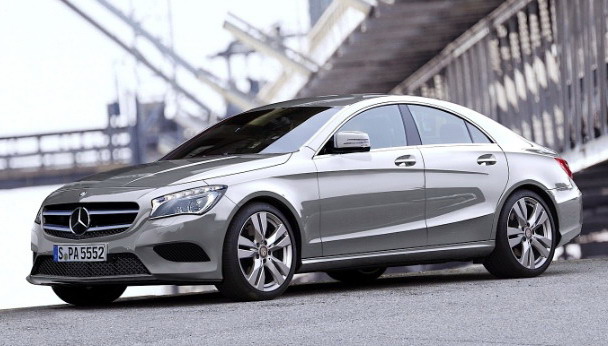
The change in emphasis for the new car, codenamed W205, has been driven by the decision to add the smaller CLA to the Mercedes line-up this coming summer.

The swoopy four-door CLA, previewed by the Concept Style Coupé, is planned to occupy a slightly lower market segment, with more affordable pricing than today’s C-class. This will allow the next C-class to be repositioned half a class higher.

Four new C-class models are planned. Alongside the initial saloon and estate, set to be revealed in March 2014, Mercedes is also preparing a more individually styled successor to the coupé as well as an all-new fabric-roofed cabriolet for launch in 2015.

All four are set to receive the go-faster treatment from AMG, which is preparing a new twin-turbocharged 4.0-litre V8 engine for the new car.

Dimensions

The length of the new C-class has increased by 100mm over today’s model to 4700mm. That puts it on a par with the Audi A4 and extends it 75mm beyond the 3-series saloon.

Some 80mm of the added length is concentrated within the wheelbase, which increases to 2820mm. Autocar can also reveal that the tracks have been widened by up to 40mm to give it a larger footprint. A corresponding increase in width takes it to about 1810mm.

The bigger external dimensions are claimed to provide the new model with significantly improved interior space. Leg, shoulder and headroom have improved in the front and rear, according to Autocar sources. The new C-class is also set to offer greater luggage space. The boot capacity of the saloon has risen to 485 litres, which is more than in an A4 or 3-series.

Chassis

The new C-class will be the first model to use Mercedes’ new MRA (modular rear-wheel drive architecture) platform. The hot-formed steel monocoque structure is, in lengthened forms, also set to underpin future incarnations of the E-class and S-class, among a whole line of models. It has been conceived using the latest construction techniques and, together with further weight-saving measures brought to the chassis, is said to help the new car to undercut its predecessor on the scales despite its considerable increase in size.

Nothing is official yet, but a new base C160 model is said to weigh less than 1380kg, despite increases in both static and dynamic rigidity, both of which are described as class-leading.

The new C-class looks likely to eschew the MacPherson strut layout of the existing model up front for a new double wishbone arrangement, providing greater wheel control and added lateral stiffness for improved handling. The rear, however, retains a similar multi-link system to the existing C-class’s, but it has been extensively redesigned for added levels of refinement.

Engines

Unlike the CLA, which uses a transverse engine layout, the new C-class retains longitudinally mounted engines. A new mounting procedure sites them lower in the engine bay and slightly more rearward than with today’s model for improved weight distribution and a lower centre of gravity.

Mainstream engines will include four-cylinder and V6 petrol units, ranging from a 184bhp 2.0-litre turbo to a range-topping 330bhp twin-turbo 3.0.

The diesels are initially likely to include an upgraded version of the existing 2.1-litre engine in up to four states of tune, spanning 120bhp to 220bhp.

All engines will receive automatic stop-start and brake energy recuperation, along with other efficiency-boosting measures. Combined with the reduction in kerb weight, this is claimed to bring improvements of up to 20g/km in CO2 emissions.

Mercedes also plans to introduce a plug-in petrol-electric hybrid version of the new C-class in 2015. Details are scarce, but sources suggest that it will have an all-electric range of up to 18 miles.

Further developments include revised driveline architecture with an altered driveshaft layout. This will allow Mercedes to produce the new C-class in standard rear-wheel drive and optional 4Matic four-wheel drive in both left-hand-drive and right-hand-drive guises for the very first time.

Up until now, driveshaft packaging constraints have caused the 4Matic C-class to be produced in left-hand-drive form only. The new layout will be adopted by the next GLK SUV, which will also be produced in right-hand drive.

The new C-class is set to be launched with a six-speed manual or a newer version of today’s seven-speed automatic gearbox, depending on the engine. A new nine-speed automatic transmission is currently undergoing development. However, Mercedes sources suggest that it is unlikely to find its way into the C-class until the next model receives its planned mid-cycle facelift, in 2017. The plan is that it will initially find its way into more upmarket offerings before trickling down through the line-up.

New tech

Adaptive damping control will be standard on all models and a new electro-mechanical steering system will offer a range of hands-off automatic parking options.

The technology that Mercedes plans to use in the new C-class includes a full range of safety features also destined for the facelifted E-class. It features a stereo camera that provides additional collision prevention functions, such as the car braking itself automatically to reduce the severity of an impact.

Also included will be a new Distronic Plus feature with Steering Assist, which keeps the car centred in a chosen lane and tracks traffic in tailbacks. There will also be Brake Assist Plus with Junction Assist, which detects cross-flow traffic and pedestrians and can boost the braking power if insufficient force is applied by the driver to avoid an impact.

Detroit motor show: Infiniti Q50


Detroit motor show: Infiniti Q50

Tuesday, January 1, 2013

2013 Ford B-Max specs


Just occasionally, it’s okay to get excited about doors. When Mercedes-Benz launched the world’s first supercar in 1954 its doors were so swooned over that the car became known not as the 300SL, but the Gullwing. And when the doors of the first Lamborghini Countach swung forward or those of the BMW Z1 sank into its sills, so too did we get excited about doors. But on an MPV? Not until now.

So it’s okay to get excited by the doors of the Fiesta-based Ford B-Max. We thought the rear-hinged back doors of the Vauxhall Meriva were quite clever, but these are in a different league. The fronts open conventionally, the rears slide like those of a van.

But between them? Only fresh air. Half of each B-pillar is incorporated into each door, providing an unprecedented 1.5-metre-wide aperture when the doors are open and all the requisite structural integrity and side impact protection when closed. They provide access to a spacious and smart cabin with a well designed and attractive driving environment.

And this is just where the good news starts. You can see for yourself good the B-Max looks, but you’ll need to go for a test drive to see how well it rides and handles. It’s a little softer than the Fiesta to reflect its more family-orientated role in life but it’s still a sharp-steering, accurate and enjoyable car to fire down the road and comes with a clearly superior ride to the Fiesta.

It has two great engines, too: Ford’s super-frugal 96bhp 1.6 TDCi diesel motor, which gives the B-Max 70mpg potential and emissions of just 104g/km, or its all-new 118bhp 1.0-litre turbocharged three-cylinder petrol engine, upon whose ultra-talented head awards continue to rain. How good is it? A 1.6 Citroën C3 Picasso has the same output and returns 40.9mpg. The B-Max claims 57.7mpg.

Now, though, for those who still remember turntables, there should be the sound of a stylus being dragged across the surface of the record, for here the hitherto sweet song of the B-Max abruptly ends.

Ford has done two things to the B-Max that seriously harm its case. First is to provide the car with a conventional rear seat. It folds of course, but unlike those of its rivals, it neither slides nor reclines so you cannot trade boot space for leg room or vice versa according to what you’re carrying. In a small MPV, that’s a proper limitation.

The second problem is easier to fix. While the high-output 1.0-litre petrol and 1.6-litre diesel engines are world class, Ford has cynically only made them available on the top grade Titanium specification. To add insult to injury both the lower spec 98bhp 1.0-litre and 74bhp 1.5-litre diesel actually use more fuel than their range-topping brethren while offering performance that’s poor for the petrol model and pitiful to the tune of a 16.5sec 0-62mph time for the diesel.

If Ford made its best engines available in the Zetec spec that most customers will choose, that would leave the fixed rear seat as its only serious failing. Left as it stands most customers will quickly realise how good their B-Max is without ever realising just how outstandingly great it could have been with a little more understanding from Ford.

2013 Skoda Rapid review


Skoda is going places. So much so that it might need to revise its production targets upwards, even from a stated goal of making 1.8 million cars per year by 2018. Globally, Skoda has hit a chord with the buying public. Its products mean the same thing everywhere: they’re good value, they’re more spacious than you’d expect and they’re adorned simply inside. It is an image that has resonated in a crisis-ridden world.

The Rapid is its latest model in a roll-out of new product that will include a new Octavia next year and a large SUV after that. But it’s the Rapid that brings some balance to the line-up, sitting as it does in the gap between the Fabia, which we’ll now think of as a conventional supermini, and the Octavia, which has hitherto been small for a Ford Mondeo-segment car, or large for a Focus-sized one. The Rapid – a straightforward, spacious, good value C-segment competitor – will occupy the ‘small family’ ground and push the Octavia up into fleet territory. To that end, it’s average-sized, of average weight and wears the kind of keen price sticker you’d expect to find on a car that is aimed mainly at private buyers.

Before its unveiling in production form, the Rapid’s design was previewed at motor shows by Skoda’s Mission L concept, a rather sleek, chunky-looking hatch that didn’t seem particularly outlandish. Pity, then, that to our eyes the Rapid, once shorn of the concept’s striking white paint and huge alloy wheels, doesn’t quite retain all of that charm. It arrives instead looking rather more staid and without the elegance of an Octavia or the cheekiness of a Yeti. It’s undramatic and inoffensive, mind you, and perhaps that’s the idea. A car that eases itself into people’s consciousness without them even knowing it.

Beneath its skin, things remain just as conventional. At 4.48m long, the Rapid would seem a likely candidate for the Volkswagen Group’s new MQB platform that already underpins the Golf, Audi A3 and Seat Leon. Instead, the Skoda sits on a development of the same underpinnings as the Fabia hatchback. There’s nothing wrong with that, but one wonders whether its torsion beam rear end will rob it of the sophisticated feel of the better cars in this class, including, let’s not forget, other budget-conscious models such as the Hyundai i30 and Kia Cee’d.

One advantage, mind you, is the weight of the Rapid, which comes in at just 1150kg. That’s lighter than the 1175kg claimed kerb weight and considerably lighter than most rivals. As light, in fact, as plenty of current superminis, and this, as we’ll see, has an advantage when it comes to fuel consumption.

At the front, the Rapid is suspended by MacPherson struts, and it has a range of engines offered straight off the shelf and available to all within the VW Group. The range kicks off with a three-cylinder 1.2, before moving to our test car’s 84bhp, four-cylinder, turbocharged 1.2. There’s also a 104bhp variant of the same unit and a 121bhp 1.4 petrol that comes with a dual-clutch automatic gearbox as standard. And there’s one diesel: a 104bhp 1.6 TDI. In our experience to date, the 84bhp 1.2 TSI of our test car represents the range’s sweet spot.

A dead-straight driving position? Check. Chunkily designed and predominantly hard-to-the-touch cabin plastics? Check. Large, analogue dials? Check. Big, round headlight switch? Check and check.

Skoda buyers, according to the company, like things simple. There’s less to go wrong and less to worry about. Skodaphiles getting into a Rapid, therefore, will feel quite at home. The seats are relatively flat but generally comfortable, while the steering wheel is large and the overall ergonomics clearly meet VW Group standards. Our test car’s rather plain radio display can be upgraded to a flashier colour monitor with navigation, but it doesn’t feel worth having here, even if it would add a dash of colour to what is otherwise a fairly austere cabin.

At the price, however, it would be churlish to criticise. Boredom would appear to be designed in, but so is exceptional interior packaging. The Rapid may be based on the Fabia, but when it comes to its interior it’s the Octavia with which it has more in common. The saloon-like rear actually features a big hatch, which opens to reveal a 550-litre boot with a high, wide opening. The rear seats don’t leave a flat floor when folded, but otherwise it’s a practical, versatile cabin. A big one for occupants, too, with rear headroom being the only hint of a compromise. This is a cabin that could accommodate four large adults, easily (with the usual caveat that three abreast in the back is cramped in seemingly any vehicle that comes from this side of the Atlantic).

It is possible to buy a slower Rapid than our 84bhp, 1.2-litre test car, but we would not advise it. Not because it’s bad form to have a car that is incapable of completing a 0-60mph dash in at least 11.2sec, as our test car is, but instead because the base 74bhp three-cylinder engine is unlikely to save you a great deal of money. It costs only a little less, in the way that headline-grabbing base engines do, yet it is expected to return significantly worse economy, is subject to higher road tax and will not retain its value so well. No, for our money, this 84bhp unit is where we’d put our interest.

In the Rapid, this engine makes a quiet and unobtrusive companion, as it does in the other cars in which we’ve tried it. At idle it is near-silent, while above that it spins quietly and easily towards its 6000rpm redline. As we’d hope for in a car aimed at – and let’s be honest here – those who are unenthusiastic about driving, it makes its peak torque figure where it is easily accessed, at just 1500rpm, which makes it easy to get the best from it. Even so, stirring the gearbox is hardly a chore, so easy is the five-speed manual’s shift action.

That five-speeder is common to all Rapids save the seven-speed, DSG-equipped 1.4, whereas most rivals would at some point in the range opt for six-speed manual units. Here in this 1.2 turbo, however, the lack of a sixth ratio makes little difference to the fuel economy, which was a strong 46.7mpg on a touring run and 39.5mpg overall – a decent result given that our testers run with more leaden right feet than most owners will. Don’t be surprised to find that an average economy figure in the mid-40s is achievable if you drive relatively sedately.

Braking performance was also good. The nature of the surface on our dry handling circuit means that, when wet, stopping distances are often longer than on the grippier, less rubbered bespoke wet braking surface. Hence the Rapid wanted fewer metres in which to stop in the ‘wet’. As such, a fine 48.1m plays 50.7m in the ‘dry’. Which was wet.

In our experience, the Rapid is a car that is particularly reactive to the type of engine it is fitted with. Our test car rode, steered and handled considerably better with this 1.2-litre petrol engine than with the 1.6-litre turbodiesel equivalents.

With the heavier diesel lump under the bonnet, the Rapid has an underlying heft to its body movements that this lighter 1.2-litre car does without, leaving this our choice in the range dynamically.

Everything it does, it does with ease – and not only more ease than other models within the Rapid line-up, but also with more ease than most of its rivals. A Kia Cee’d and Hyundai i30 have intentionally had a feel of greater dynamism engineered into them. Ditto a Ford Focus and Vauxhall Astra. The Rapid, meanwhile, goes about its business in a slightly old-fashioned, easygoing way. The control weights are all consistent and light and it rides with medium pliancy, trading a loping gait for some body control but ending up neither truly comfortable nor truly deftly damped.

It displays, in its handling, the same sort of thing it exhibits in so many other areas: middle-of-the-road competence. If that’s where Skoda was aiming, and we strongly suspect it was, then it has hit the mark. It just seems a shame that, for a company whose other products manage to incorporate value for money with a driving experience that feels like some effort has been poured into it, the Rapid feels like a retrograde step compared with, say, the Yeti.

Skoda executives have freely admitted to us that, if you look within the Volkswagen Group at failure rates, breakdown frequency and overall, measurable, tangible quality, Skoda actually fares no better than its VW sibling. Yet when it comes to customer satisfaction surveys, Volkswagen, which sells more fleet cars to higher-mileage, higher-speed and more demanding users, never performs as well as Skoda.

This, Skoda’s engineers and managers think, cannot be expected to last as Skoda grows, so the company is enjoying it while it still can. Certainly the impressive fuel consumption we recorded in the Rapid will please most owners if it appeared on their trip computers. Skoda’s enviable reputation as a maker of practical cars that offer good value for money when new means that residual values should remain as strong as anything within the class, too. Especially when you consider that there isn’t a great deal within the Skoda’s class. Plenty of mid-size hatches have an alluring ‘price from’ figure, but they quickly hop from there to a place the Skoda still manages to undercut.

There are those for whom the Rapid will make perfect sense. We can even imagine ourselves recommending one as a used buy in the near future. But, given where Skoda has been recently, and given the innovation and perceived quality of the products it otherwise offers, the Rapid fails to satisfy quite as much as it potentially could have done.

Instead, the Rapid is the car reduced to the level of a supermarket’s own-label loaf of bread, or an unbranded fridge with no egg holder. Its practicality and value is unquestionable, but there’s nothing to make you want one other than the price on its nose and the inches in its cabin. There’s nothing wrong with that. It’s just that, as enthusiasts, we look for something more in a car.